Austro-Hungaria, Military cemetery in Berezhany – then and now.

In todays world doing research on the internet often delivers great info. This happened when I was looking into some photo’s of Captain Swoboda who was an engineering officer in the Austro-Hungarian army in WW1.

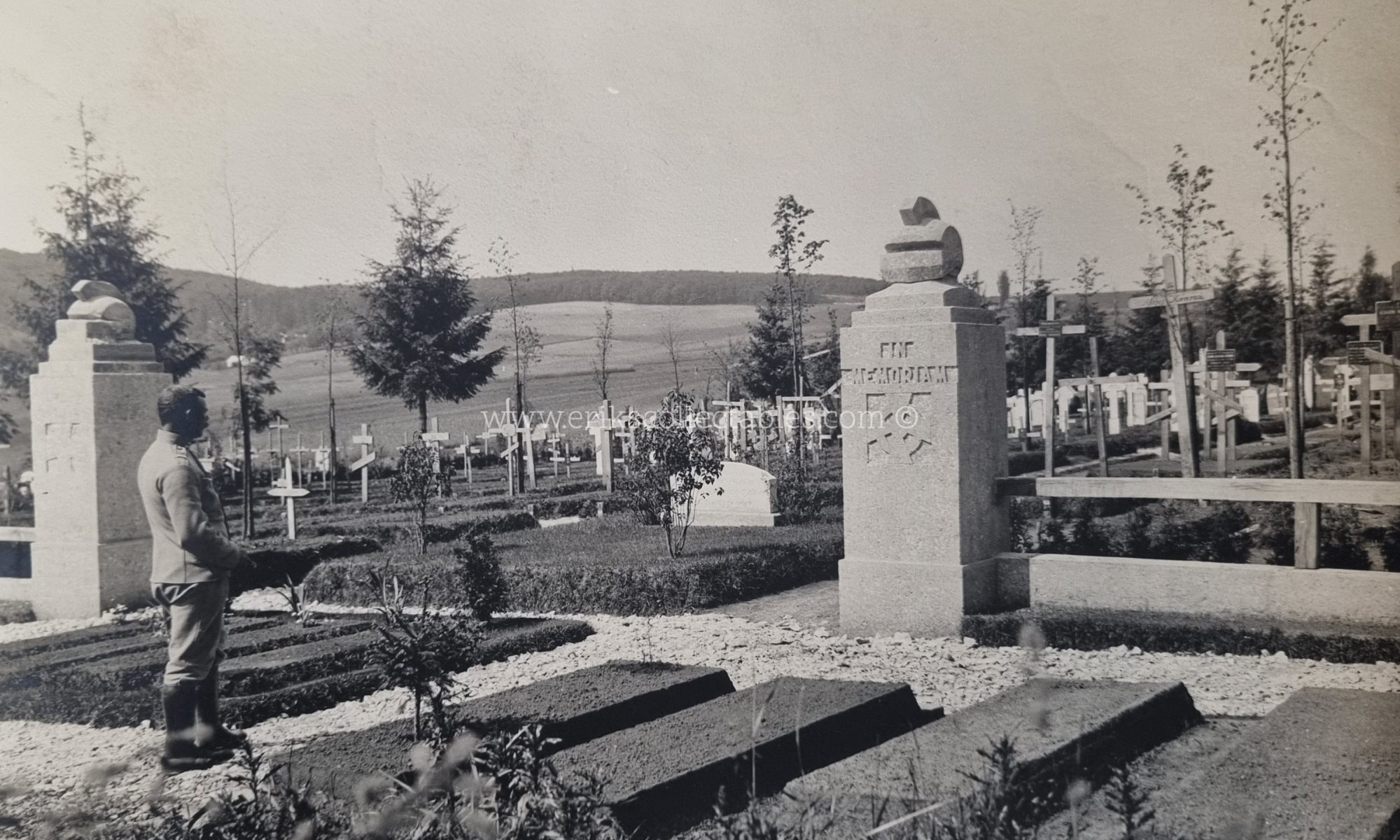
While his main task was building bridges and such there were also some photo’s of monument for a military cemetery in the group. He built these in the city of Berezhany (today in Ukraina) after the city was captured by Austro-Hungarian forces in 1916 from the Russians that had invaded the city before.

Searching for the cemetery on the internet I found some recent photo’s on Wikipedia with the current situation of these monument so here is a quick comparison – then and now:

Photo from Wikipedia
And the caption on the back of the original photo

Also the central cross still being built in 1916 and how it looks today:

And as the last one a grave for an officer (Oberleutnant Franz Volbrecht of KuK IR Nr 75) that still exists today:

Source: colour photo’s from Wikipedia

Austro-Hungaria, Grouping, Carl Öhlzelt

Carl started in the KuK (Schutzen) Landwehr Infanterie Regiment 21 (Sankt Pölten) and later his machinegun group moved to the Landsturm Infanterie Regiment Nr. 51.

Sometimes as a collector you come across a grouping that is quite unique as in this case. At the moment I am still contemplating what my next step will be….A series of blogs, a dedicated website or even a book…

The group contains a photo album with a cover with badges of Carl, many postcards and a short diary. Loads of information on some very relevant moments in WW1 including the Isonzo battles.

Until I have decided what to do only a small placeholder blog with some teaser materials…

The album contains many official photo’s, but also private photo’s and even WW2 related photo’s. Also many captured Italian photo’s and some leaflets (Flugblätter). So for now only this teaser…

Vitéz stories III – Sergeant Joföldi, KuK IR 38

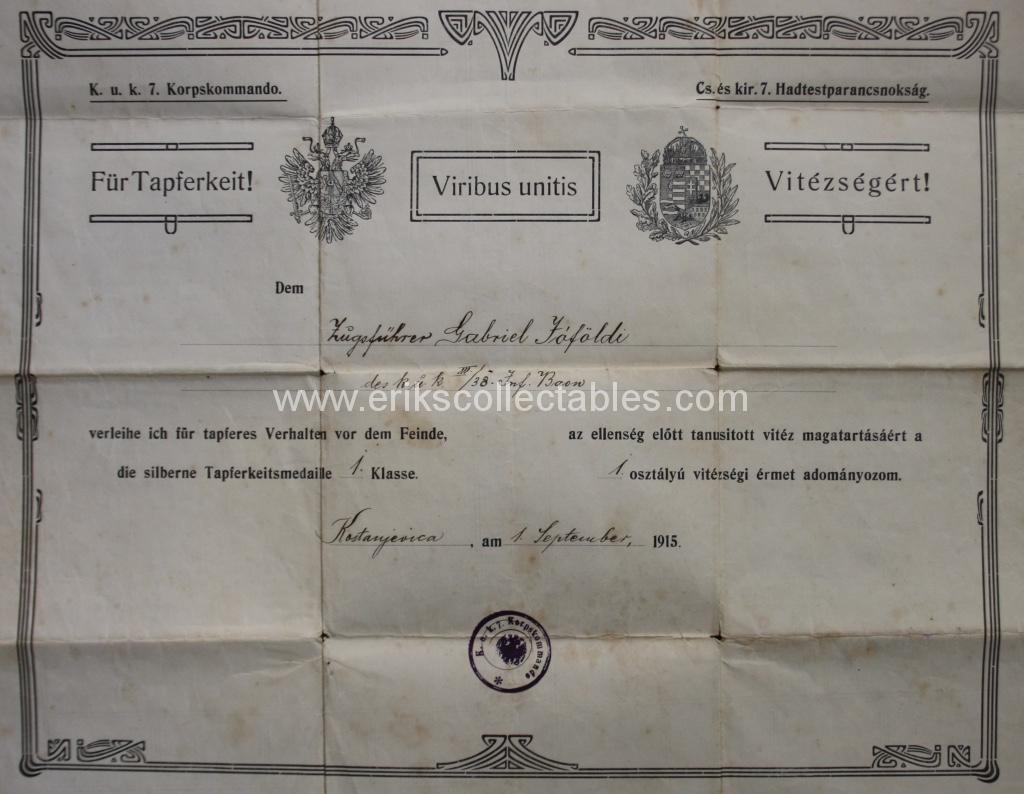
These are the documents and medals of sergeant in the reserve vitéz Jóföldi Gábor.

Complete WW1 entitlement including vitéz order and certificate

The following information comes from the history of the 38th KuK regiment by József Doromby :

Photo from the regimental book.

“He was born in 1885 in Bogyiszló. In 1907-09 he fulfilled his military duties in Bilek. He was involved in the mobilization and trained as a reserve NCO until January 15, 1915. After that he went to the Serbian front, and from there on May 13, to the Italian front. He went to Doberdo, Italy and then he was taken back to the Serbian front and then again to the Italian battlefield, from where in April 1916 he was taken sick to the hospital. After his recovery, he was commanded to the Russian, Romanian and finally again to the Italian front. Wife: Judit Bencze; children: Judith, husband. Mrs. János Sánta, Gábor, Lidia, husband. Mrs. Józsefné Németh, Ferenc. “

The piece in the book also give his full medal list as shown above. He did not qualify for the Wounded Medal as his period in hospital was due to illness, not wounds received in battle.

His Silver Bravery Medal 1st class would be the basis for his later (1929) introduction into the vitéz order. Below the full size diploma which is quite rare as most units only handed out the small certificates for in the legitimation capsule.

Below some other papers, his 1919 release from service papers, the certificate for his Karltroop cross and his Hungarian WW1 remembrance medal.

He was mobilized again for WW2 (Igazolvány lap in the top middle) but probably did not see any action due to his age.

All papers and medals came from the family and are a real group. Below a “Kappenabzeichen” of the 38th KuK Infantry Regiment in which he served (my collection but not part of his estate!)

With thanks to Zoltán Sőregi for finding the regimental information!

Austro-Hungaria, Airforce officer painting – Flying Ace Rudolf Szepessy-Sokoll?

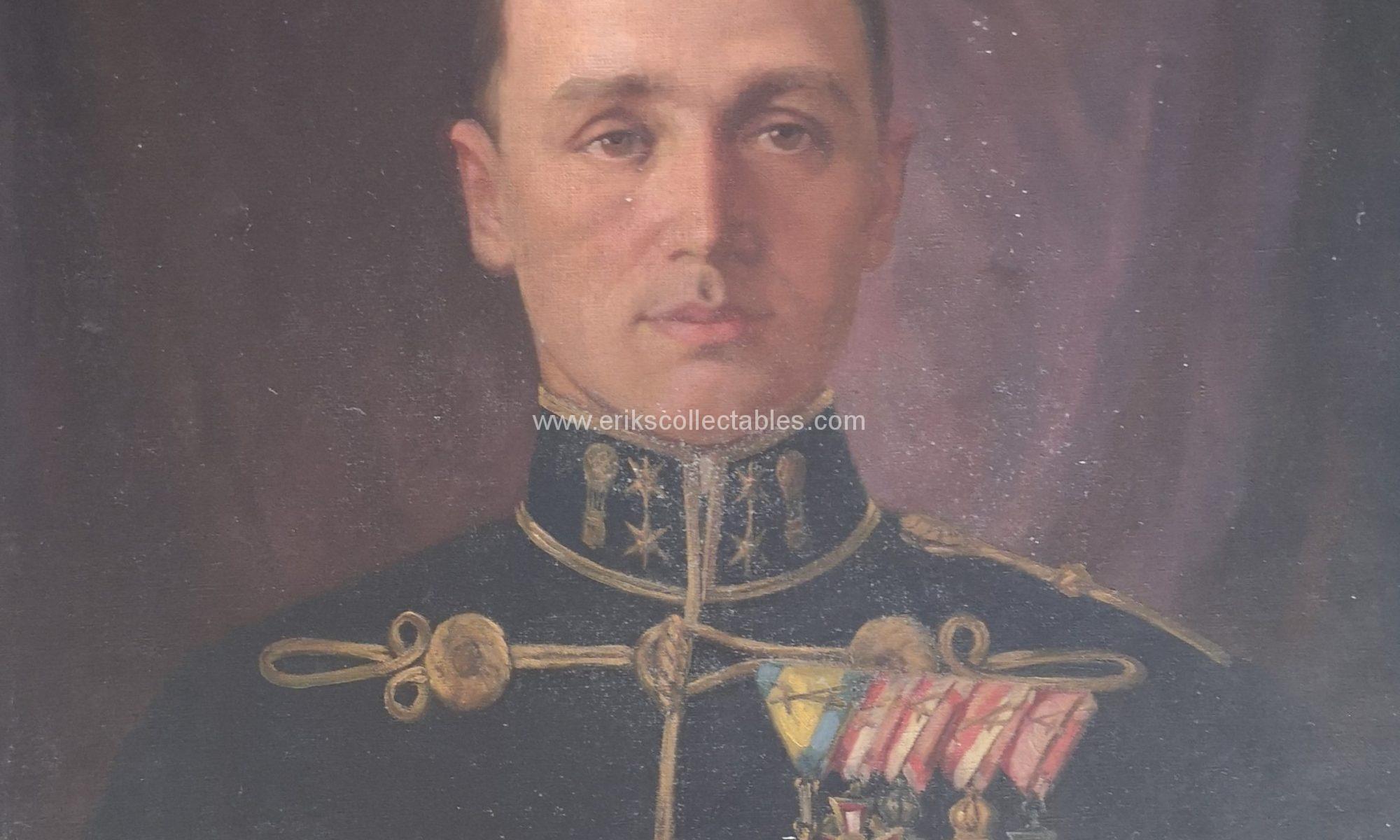
A painting of a WW1 Hungarian Airforce 1st Lt. with a high level of decorations. The painting is dated 1938 and by the Hungarian artist Csermely János.

He wears the uniform of a Hussar with the additions of the flying balloon insignia. He looks in that respect very much like flying ace Szepessy Sokoll. He is often depicted in the same Hussar uniform but the medals do not fully match. The silver bravery medal first class is missing and the German cross that is visible on the painting left. The other medals are correct for him including the Iron Crown order he received posthumously also the rank is correct!

I think the officer probably died in WW1 and this painting is based on a photo and the medals are added with the info available to the painter. So it might be Szepessy-Sokoll only the medals are not complete?!

The level of decorations on the painting suggest that the officer is a very succesfull pilot, maybe even an ace. The Iron Crown order 3rd class was very rarely given to low ranking officers. Normally Lt-Col or above although in war cricumstances the actual acts of bravery or merit were leading. So in all likelyhood it is him with a misstake in the medals.

If you have additional info please contact me!

Austro-Hungarian Mountain Artillery

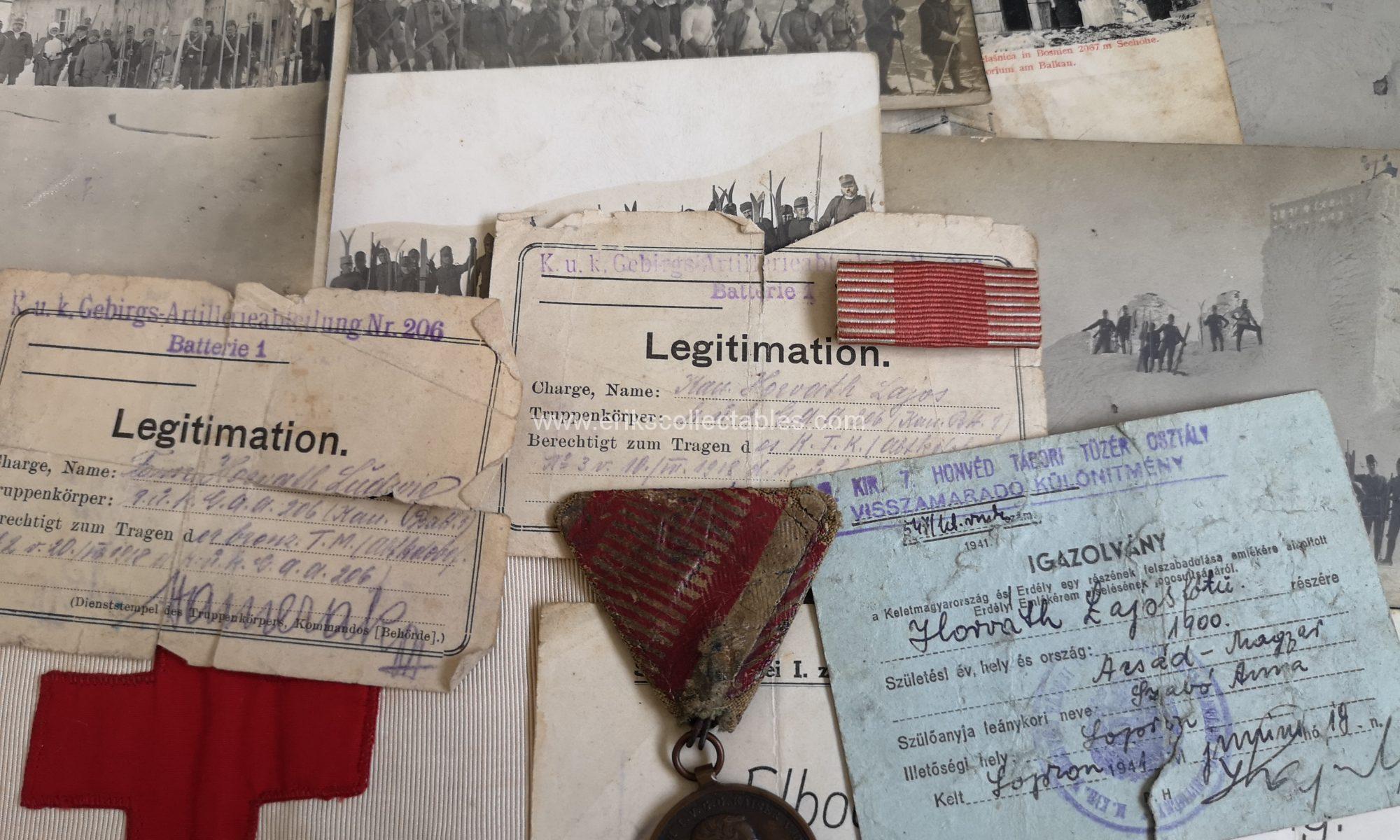
This small grouping to one man, KuK mountain artillery. Gebirgs-Artillerieabteilung Nr 206, Batterie 1.

The papers are for his bronze bravery medal and his Karl Troop cross.

His leave paper from 1919 and based on the last paper in this group he also came into action during the Hungarian 1941 Erdély campaign as part of the artillery.

Including pictures of a ski trip on the well known Bosnian Bjelasnica mountain.

Up to the observatory. This mountain was an important strategic location and even was used in the last Bosnian war 1992-’95. At the top there is still an observatory today.

The postcard came with the group. It always nice to have a known reference point to a group of pictures!

Austro-Hungarian War Cross for Civil Merit to German Police Commisioner Theodor Dix, Leipzig

The name of this decoration tells exactly what it is, a cross for civilians that showed merit during war time assisting the Austro-Hungarian empire. The cross existed in four classes and could be awarded both to foreigners and citizens.

The third class was in silver, 2nd class gilded and 4th class bronze. The document are related to the 3rd class so a silver one as pictured above (photo from internet).

Letter that accompanied the actual award document

The documents in this blog are made out to a German police commisioner (Polizeirat) from Leipzig named Theodor Dix. And as it often happens with researching civilians that is where it more or less stops…

With the development of online research possibilities more and more sources are available. So maybe in the future I hope to extend this short blog.

So far only this showed up:

It states that Dix held a presentation for a society regarding “Use and succes of our Medical dogs on the battlefields. So my working hypothesis is that he was in his role of police commisioner involved in these sanitary dogs that were used by many armies at that time including the German and Austro-Hungarian forces. Photo’s below from the internet, not my collection.

Historical riddle – Dutch officers on the Eastern front WW1?

This is adapted and translated version of an article I published in Decorare in 2011

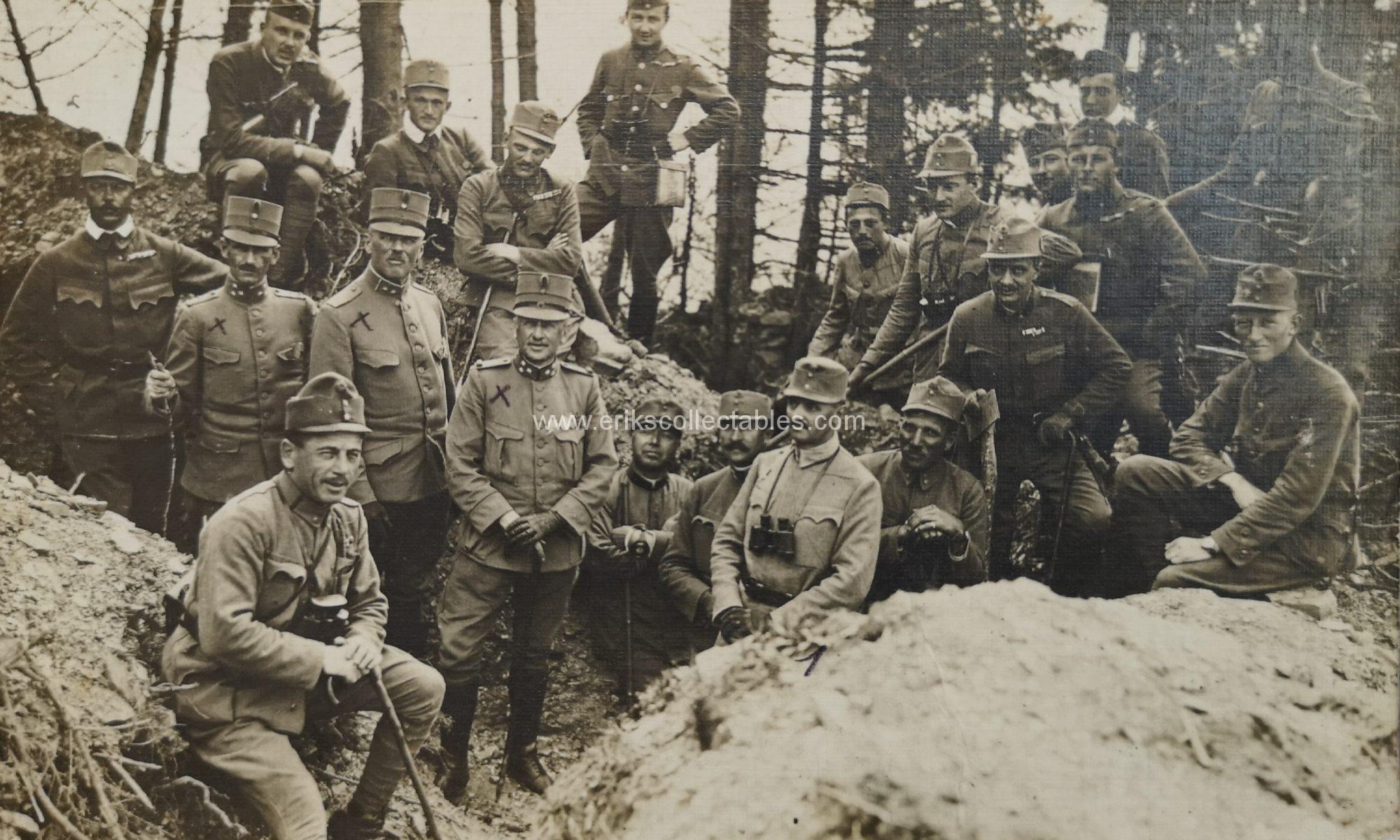
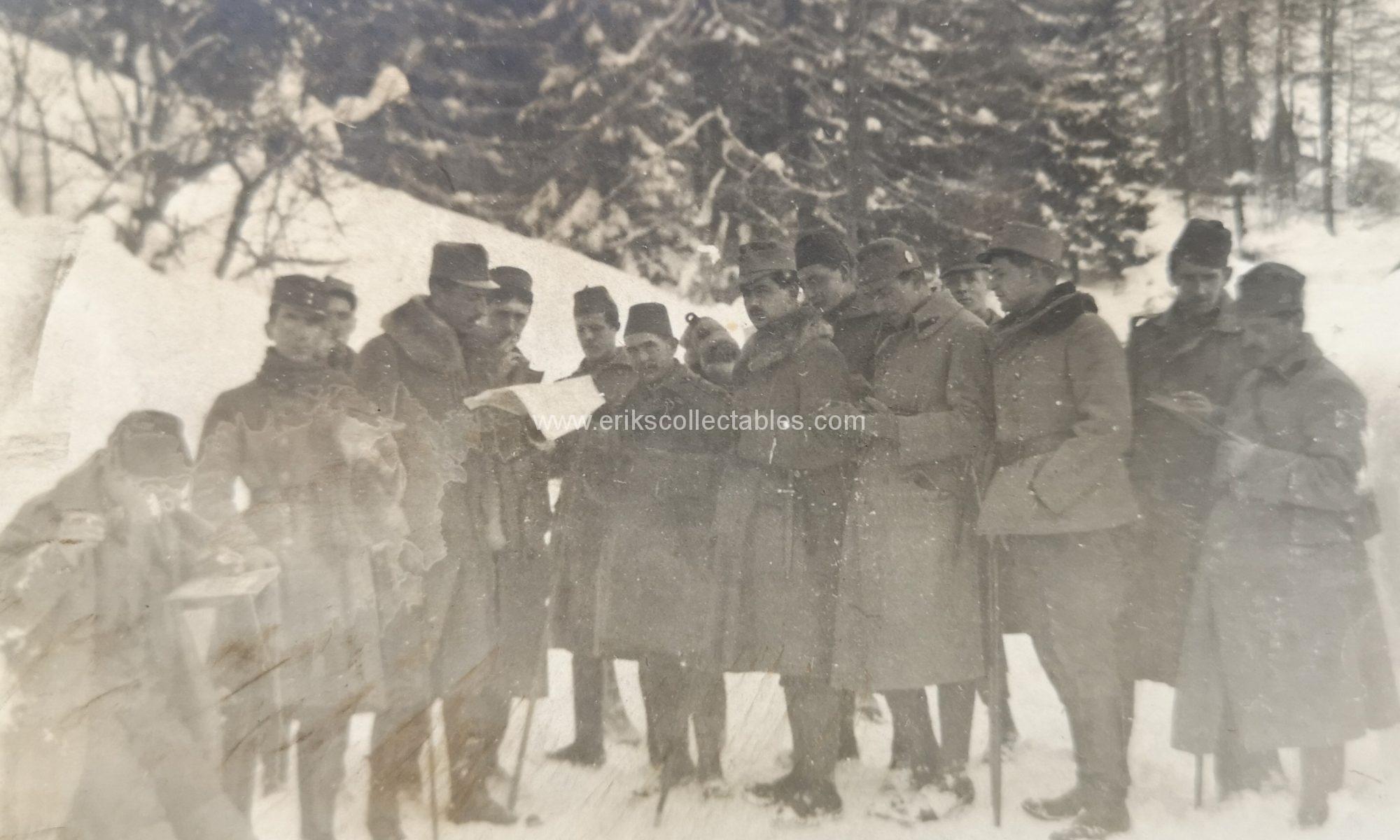
What is this photo?

After finding the photo that is the theme of this blog I saw myself confronted with something impossible. Dutch military officers among a group of Austro-Hungarian soldiers, so probably on the eastern front in the first World War?

As you may know the Netherlands were a neutral country during the first worldwar (and they tried, unsuccesfully, to do the same in the second world war – but that is a different story). Surrounded by warring countries the war had a great impact on the Netherlands but there was no military participation of any kind so the big question that arised is: what is the story of this photo?

The photo had a Hungarian text on the back that helped to shed some light on this. It can be translated as follows: Dutch officers visiting Lieutenant Colonel Safrán. So the Dutch are not participating but visiting the front and we know whom they were visiting, a good starting points for further research.

mm

Timeframe established!

Like most countries the Austro-Hungarian army also published rank lists with information on officers, these are a great source of information. During peacetime the lists (thick books) are almost perfect but during war time with rapid promotions, casulaties and all kinds of unregular changes they become less and less trustwothy. Nevertheless I could find (with the help of some research friends) that he was promoted to full Colonel in November 1917. So the photo must be from before that date. Another clue is the uniform the Dutch officers are wearing – it was only introduced in 1916 so the period is between 1916 and the end of 1917.

Study tours to the frontlines

Why would Dutch neutral officers visit the front of a war they are not part of? Well the First Worldwar changed the face of warfare in a shocking way. A neutral country could not learn from their own experience what this impact was. The only way to learn is by studying the experiences of others. So in that direction goes the second part of the research. There is only one publication on this subject written by Sven Maaskant. He states that between 1914 and 1920 approximately 60 tours were made by Dutch officers to study the effects of the war and the impact for the Dutch armed forces. After some research I succeed in contacting Maaskant and mail him a copy of the photo. He instantly recognized one of the Dutch officers. It is Lieutenant-Colonel T.F.J. Muller Massis who was the Dutch military aide to the Dutch embassies in Germany and Vienna between 1916 and 1920.

With that information he also can determine the specific trip out of the 60. Only one trip fits the participants, timeframe and location. It is a study tour to the Austro-Hungarian front that was made between June 25th and July 31st 1917. The four participants were: Colonel D.G. van der Voort Maarschalk, Lieutenant-Colonels T.F.J. Muller Massis and E.M. Carpentier Alting and Captain W.J. van Breen.

Carpentier Alting, an officer of the Dutch East Indies army is not in this picture, did he make it or was there another reason for his absence? The tour would have been organized by Muller Massis in his capacity of military aide in Berlin and Vienna. An officer that would raise to the rank of General and commander of the Dutch field army from 1922 until his pension in 1928 after which he would become a member of parliament untill 1948.

In 1933  Muller Massis donated a collection of helmets and gasmasks of different countries that participated in the war to the Dutch National Military Museum. He wrote about this: “The object were picked up by me during the visits I made to the battlefields. Further I still have the German gasmaks that was supplied to me in my function as military aide in Germany and that I wore on several fronts.”  The donation also held his collection of Austro-Hungarian distinctives. These are the so called “Kappenabzeichen”, unofficial badges worn on the military caps by Austro-Hungarian troops which he collected during these trips. On the picture in question can be seen that the 3 Dutch officers al wear such insignia on the left breast of their uniform.

What is the unit in the photo?

Some research on the Hungarian officer in the pictures gives the specific unit, the 10th Honved (Hungarian territorial army) Infantry Regiment (HIR) which was part of the 39th Honved Infantry Division which is confirmed by a “Kappenabzeichen” on the breast of one of the Dutch officers which is of this division.

mm5

Wy this unit?

In March 1917 the 39th HID waged a very signifact battle against Russian troops on the realively new Rumanian front in which the 10th HIR of which Safrán was the commander played an important role. The entire unit was used as Stormtroops. The use of Stormtroops was a new military development of the Germans that was quickly adopted by their Austro-Hungarian allies. These troops were used mainly to force breaktroughs in the stallmate of trenchwarfare and new tactics and weapons were deployed by them. They were the first to get handgrenades and machine guns but also helmets and gasmasks which were not widely spread yet with the Austro-Hungarian army. They can be seen as an early variation of Special Forces within the army, receiving addtional training and equipment in comparison with the regular infantry.

The entire action of the 39th division would literally become a textbook example for the Hungarian (Ludovika) officers academy of a Stormtroop attack. In the fight for Hill 1504 (Magyaros near the Uz river) there were hardly any Austro-Hungarian casulaties but the Russians sufferend hundreds of casulaties and a multitude of were taken as Prisoners of War. A good reason for a visit of Dutch officers to learn from this example attack only a few months later especially a good promotion for the Austro-Hungarian army that struggled with its performance in other places.

From hypothesis to proof

The Dutch Institute for Military History has the archive of Muller Massis that also contains his (formerly SECRET) report from September 1917 on the “Commission sent to visit the Austro-Hungarian fronts”. It is a sort of diary of the trip with several appendices on specific military themes. In his reports he also describes how they received “Kappenabzeichen” as gifts. Here some translations relevant to this article:

“July 3rd.
With this regiment we learned 
for the first time about regimental and other insignia 
which were attached to the headwear.  
As momento of our visit to the  
von Hindenburg regiment we each received
a similar badge with a in white metal
portrait of the “Inhaber” or owner
surrounded by a wreath of laurels and a ribbon 
in enemal with the years 1914, 1915 and 1916
and the words v.hindenburg K.u.K. Inf. Reg. Nr. 69.”

That same badge is depicted below and is still part of the collection of the Dutch National Military Museum today.

073149_jpg_1920x0_q85

The report also confirms date and location of the photo.

“July 7th. 
    Guided by several officers
we visited the first line of defense of the 10th
Honved regiment, wich line was a very short
distance away from the enemy line. Here 
also the hostilites had not commenced again
which even made it possible to get in front of the trenches.
After visiting some trenches of neighbouring 9th Honved regiment,
we walked down to the customs office
The starting point of a forresttrain (waldbahn) to Rumania. 
from here we went back to the headquarters of the 39th division.

Without the mentioning of Safrán in the text we can date the picture to July 7th 1917. Most information was already completed when the confirmation in the form of the original report was found. This shows that with thorough research it is possible to determine much valuable information.

In order to do this I had help from several other researchers, many thanks to my friends in making this article possible!

Sources:
Austro-Hungarian Namecard of Arthur Giesl Freiherr von Gieslingen

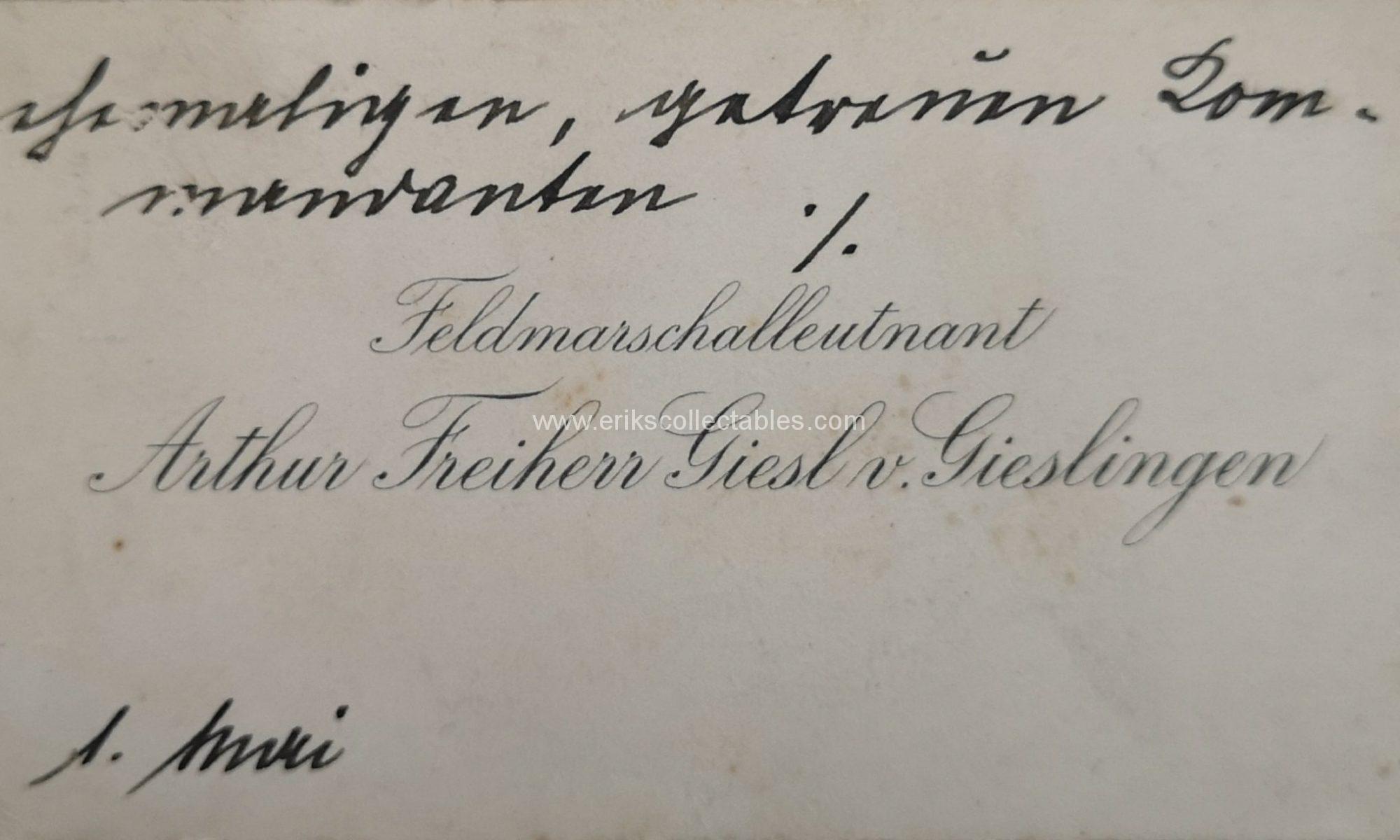
Sometimes as a collector you find unexpected treasures. Years ago I bought some paperwork with which came a group of namecards from the Pehm family. Going through the cards one stuck out:

Feldmarschallleutnant Arthur Freiherr Giesl v. Gieslingen

Based on the rank the card dates between November 1907 and Oktober 1912. He used this card as a quick thank you note/letter to a Pehm, referring to him and other students he comes across in the field and that are doing well. He was the commander of the Theresian Officers Academy between 1905 and 1910 so this must refer to his activities there where this Pehm (and a Krainz he mentions) were his students.

In the collection there are two Pehms with officers ranks so I am not sure which one is adressed here?

Mayerling and Redl

Von Gieslingen had a long career but two incidents are notable. He was attached to Crownprince Rudolph at the moment he commited suicide in the Mayerling hunting lodge. The whole affair was handled by Von Gieslingen.

His impact in the Redl affair could be even greater. He brought Redl as a young Russian speaking officer into the Evidenz bureau (Military Intelligence) of which Von Gieslingen was the commander at that moment. Later he made him his Chief of Staff of the 8th Corps in Prague. Redl as spy for the Russians probably gave all detailed plans for war to the Russians. The poor handling of the Redl case might even have been a main reason for the extremely poor performance of the AH army in the first war year. The plans most likely fell in the hands of the Russians but were not altered as Von Gieslingen claimed they had not been compromized. His own relieve of command in 1914 due to poor performance might have been a result of this too.

A great short bio about Von Gieslingen can be found here:

http://www.austro-hungarian-army.co.uk/biog/giesla.htm

Austro-Hungarian Machinegun Detachments

Although Machine Guns were not new in the beginning of WW1 they were still quite rare in the Austro-Hungarian army with only 2.700 pieces in the entire army.

During the war the importance of the machinegun became clear and many new machineguns were produced and deliverd to the infantry but also to cavalry units (that often became dismounted) during the war and of course the mountain troops. By the end of the war more than 40.500 machineguns would be in use!

Badges of the Machinegun Units

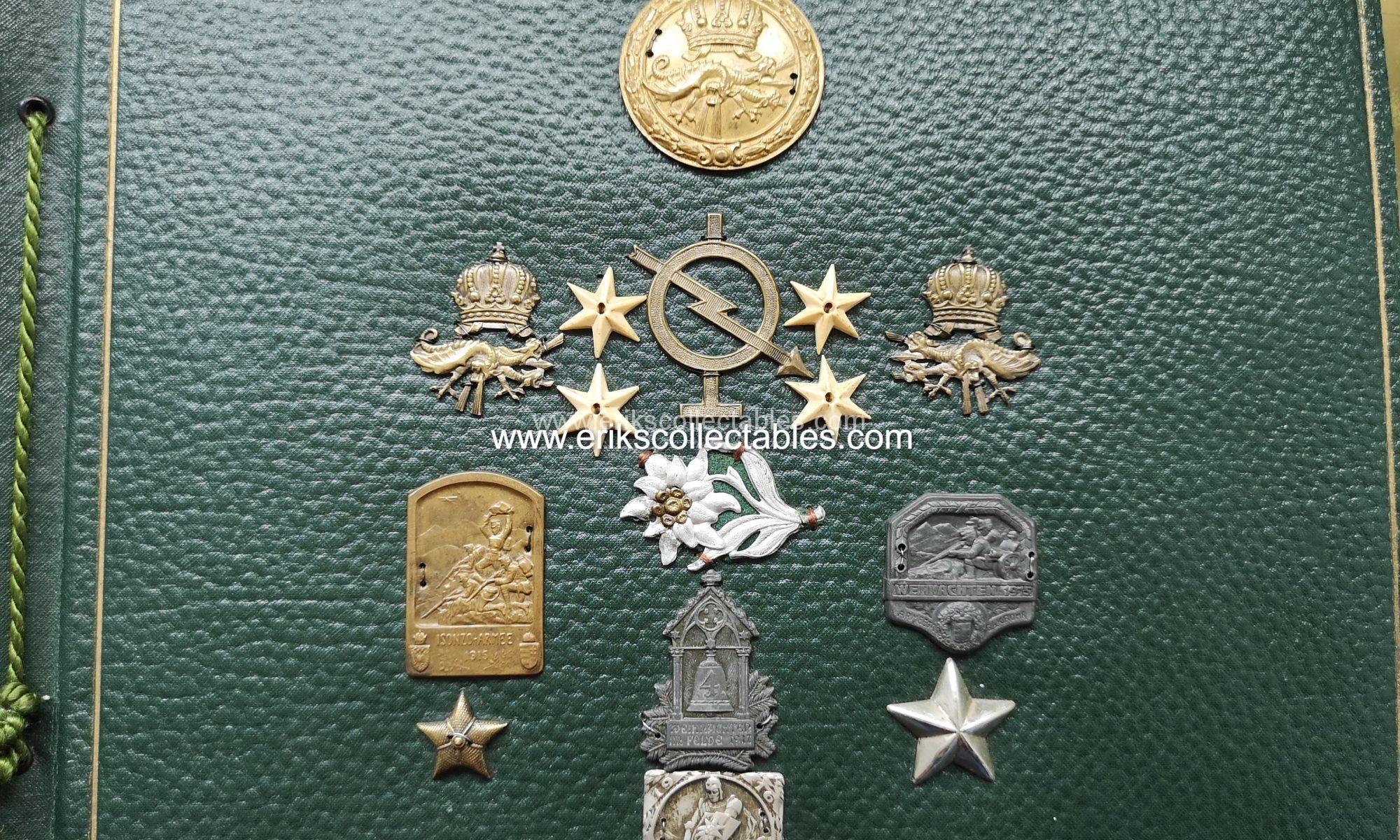
Machine gun units could be recognized by the specific collar badge as can be seen above (left and right). It depicts a three headed dragon spraying fire in all directions. The specific cap badge for machine gun units can be seen in the middle between the rank stars.

Badges as mounted on a photo album by the original owner.
The official announcement for the above badges

There was a proficiency badge for machinegun markmanship. The badge also with the dragon. It could be worn on the right breast above the pocket.

Below pictures of the actual badges on the photo album being worn by the original owner who was part of the Machinegun Company II of KuK IR 51.

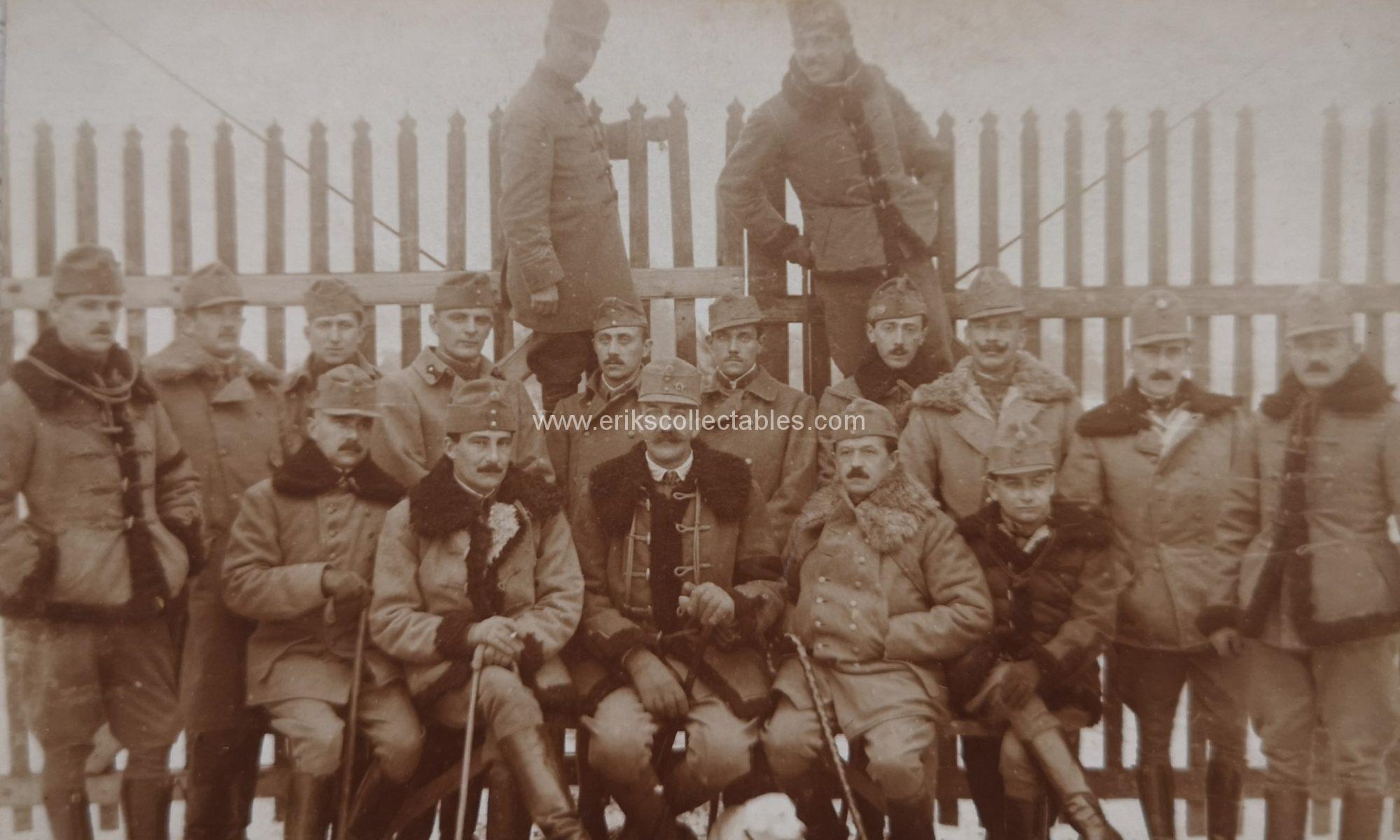
Below examples of Machinegun collar badges being worn on different uniforms of men of several different units!

The back from the postcard above right, also part of Honvéd Huszar unit!

Cavalry: KuK Dragoons and Honved Hussars

The cavalry units that became dismounted during the war and most often acted as regular infantry. They also had machinegun detachments in their regiments. The collar badge was the same as can be seen with the Huszar in the photo above. But the clothing could be different, specifically the jackets had some different versions.

Honved Cavalry Machinegun detachments Field Grey Fur Jacket being worn in the photo above and next to it a photo from the book The Emperor’s Coat describing this type of coat.

Dragoon officer of a Machinegun detachment with the regular Dragoon’s fur coat with white lambskin and not the black version.

Cavalry Machine Gun unit with a nice variation of all of the coats shown and discussed above! Both the Honvéd and the regular KuK cavalry versions

Photo probably of Husaren Regiment 14, HR14 based on the Kappenabzeichen of the officer in the middle (recognized by Hermann Attila)

KUK IR 48 – Machinegun Instruction detachment

And a document from my collection the Belobende Anerkennung (Bronze Signum Laudis medal equivalent) or honorable acknowledgment for the Commander of a Machinegun Instruction unit of KuK Infantry Regiment 48. He received the document upon his leave of this command.

Machineguns in the field. All period pictures and the paperwork are part of my collection.

Source: The Emperor’s Coat by Dr. Ortner

Austro-Hungarian Marchbatallion XXVI, BH2 – Bosnian Infantry Regiment 2

These are pictures of an officer from Trautenau who volunteered (1 year volunteer) and became an officer in BH2 together with several of his friends or familiy members. The earlier pictures in this blog came from the same album!

Photo while still as an aspiring officer (so NCO in rank, training as an officer) in 1916
Sitting in the middle
Back row, second from left, now as a decorated officer (in training)
On the right side Almasi, on the left Erben (GBM) and the third from left Edelsbrunner with EK2
Edelsbrunner left, Almasi right
And as a decorated officer in 1918
Both Almasi brothers at the back, Edelsbrunner front?

The older brother on the left was an artillery officer and of him I will make another blog!