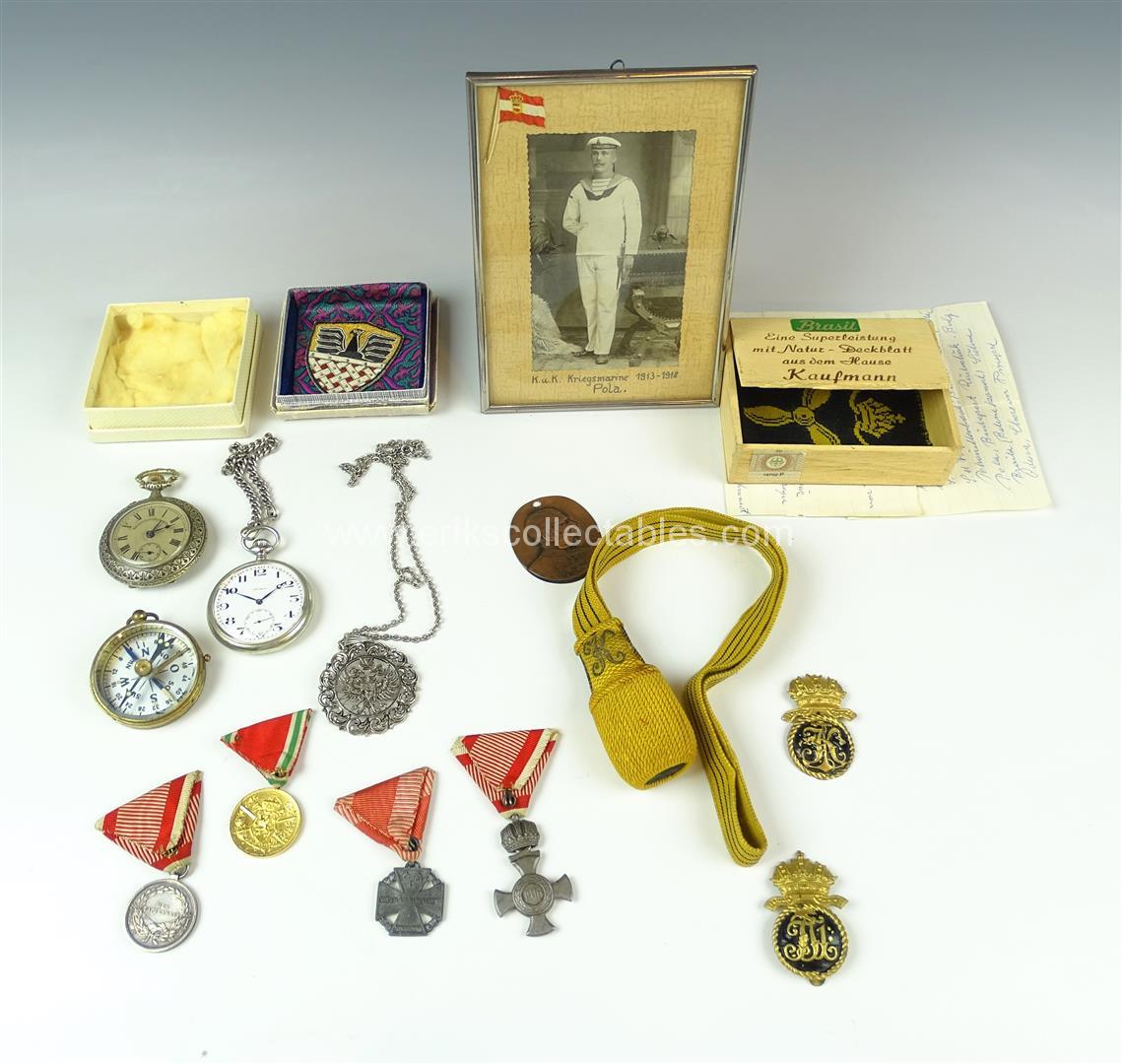
This very nice grouping of Maschinen-Maat Hans (Johannes) Knoll of the Austro-Hungarian Navy was found in the Netherlands including his handwritten notes on the items and his service.
Maat is the name of the NCO rank he had and Maschinen (so a mechanic) was the trade in which he was active. A special arm badge was used the show the trade, woven or printed for NCO’s and in embroidered bullion for officers.
The white example from the white uniform in the photo below and the blue version for on the work uniform.
He was active on different ships during the 5 years (1913-’18) he served. In the picture below he is wearing the tally for Patrouillenboot Barsch of the Danube flottila but he also was active on regular navy ships that are listed on his note further in the blog.
The trade badge can be seen here on his left sleeve, also note the capbadge and the tally for Patrouillenboot Barsch.
And his cap badges from the Kaiser Franz-Joseph and Kaiser Karl period, each with a different cipher.
The group included his personal watch, a Doxa, a compass and a souvenir watch for the Jubileum of Kaiser Franz Joseph:
But for me as a medal collector the most important part is his medal group:
The silver bravery medal 2nd class was awarded in februari 1917, unfortunately I do not know yet for which action and on which ship:
And his notes on the items and his service!
A list of his medals and at the end his name.
A list of ships and locations in which he was active.
In this form it is a very nice and rare bravery group for the Austro-Hungarian Navy!
In todays world doing research on the internet often delivers great info. This happened when I was looking into some photo’s of Captain Swoboda who was an engineering officer in the Austro-Hungarian army in WW1.
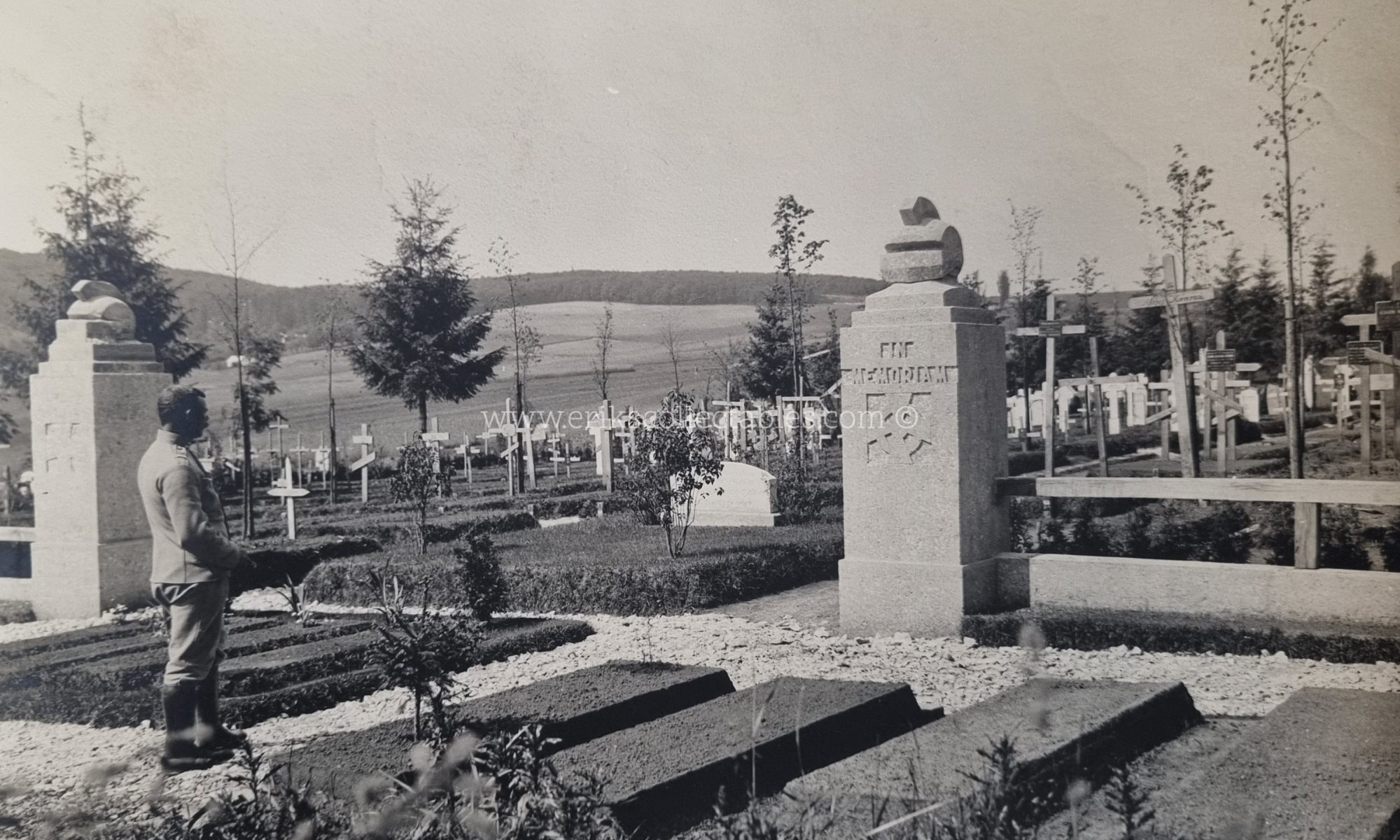
While his main task was building bridges and such there were also some photo’s of monument for a military cemetery in the group. He built these in the city of Berezhany (today in Ukraina) after the city was captured by Austro-Hungarian forces in 1916 from the Russians that had invaded the city before.
Searching for the cemetery on the internet I found some recent photo’s on Wikipedia with the current situation of these monument so here is a quick comparison – then and now:
Photo from Wikipedia
And the caption on the back of the original photo
Also the central cross still being built in 1916 and how it looks today:
And as the last one a grave for an officer (Oberleutnant Franz Volbrecht of KuK IR Nr 75) that still exists today:
Photo albums can be a great source of historic information but sadly often the context of the photo’s has been lost over time. This blog is in regard to such an album that has been in my collection for a long time. Recently I dove into it again and now with the modern digital sources I found an interesting background.
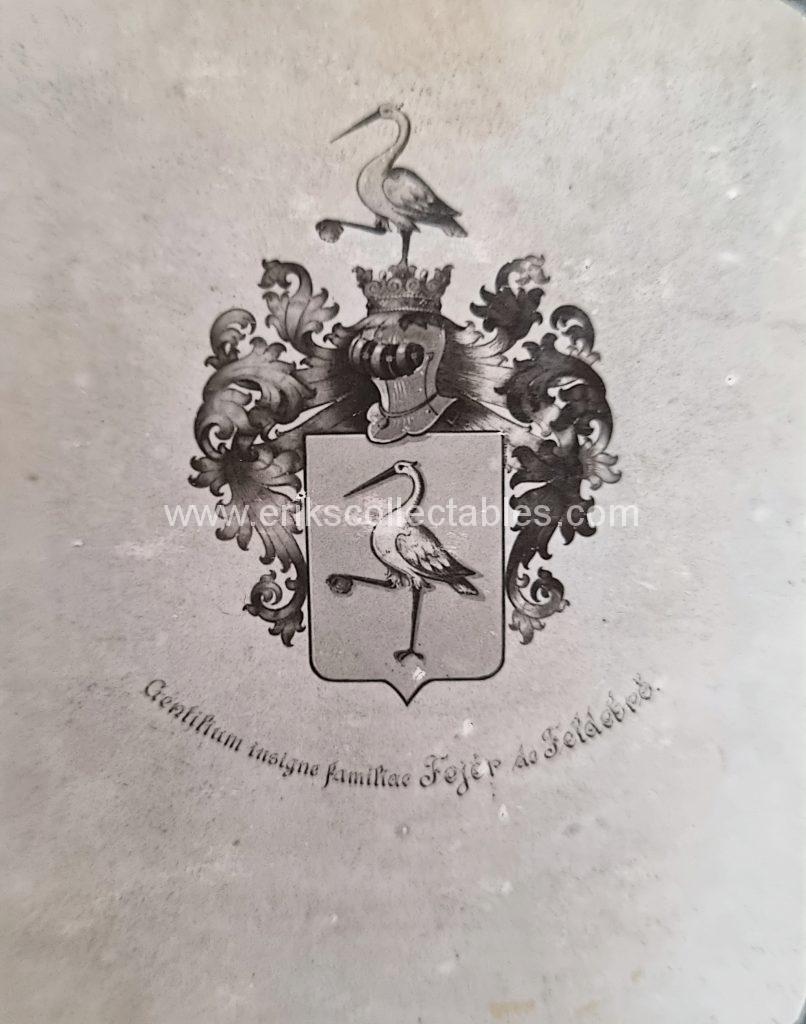
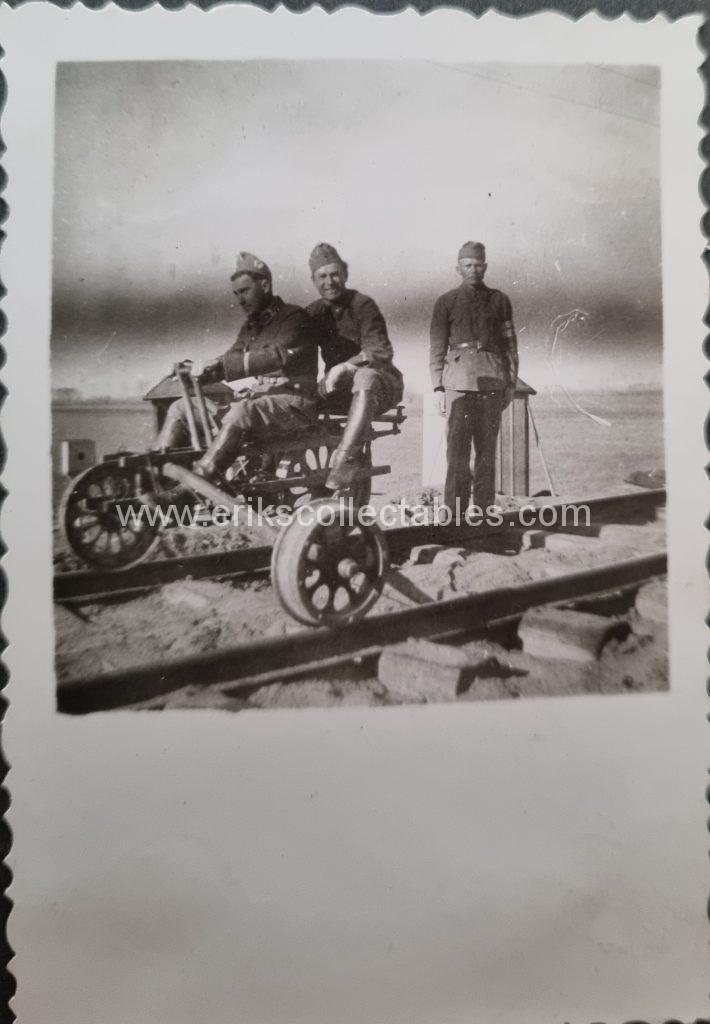
The photos seem to be of an NCO in a Hungarian military unit that is involved in railway repairs. There is family crest with name in the beginning of the album and next to the military photos there also some pictures of the man with his family but I have not been able to establish anything beyond the family name.
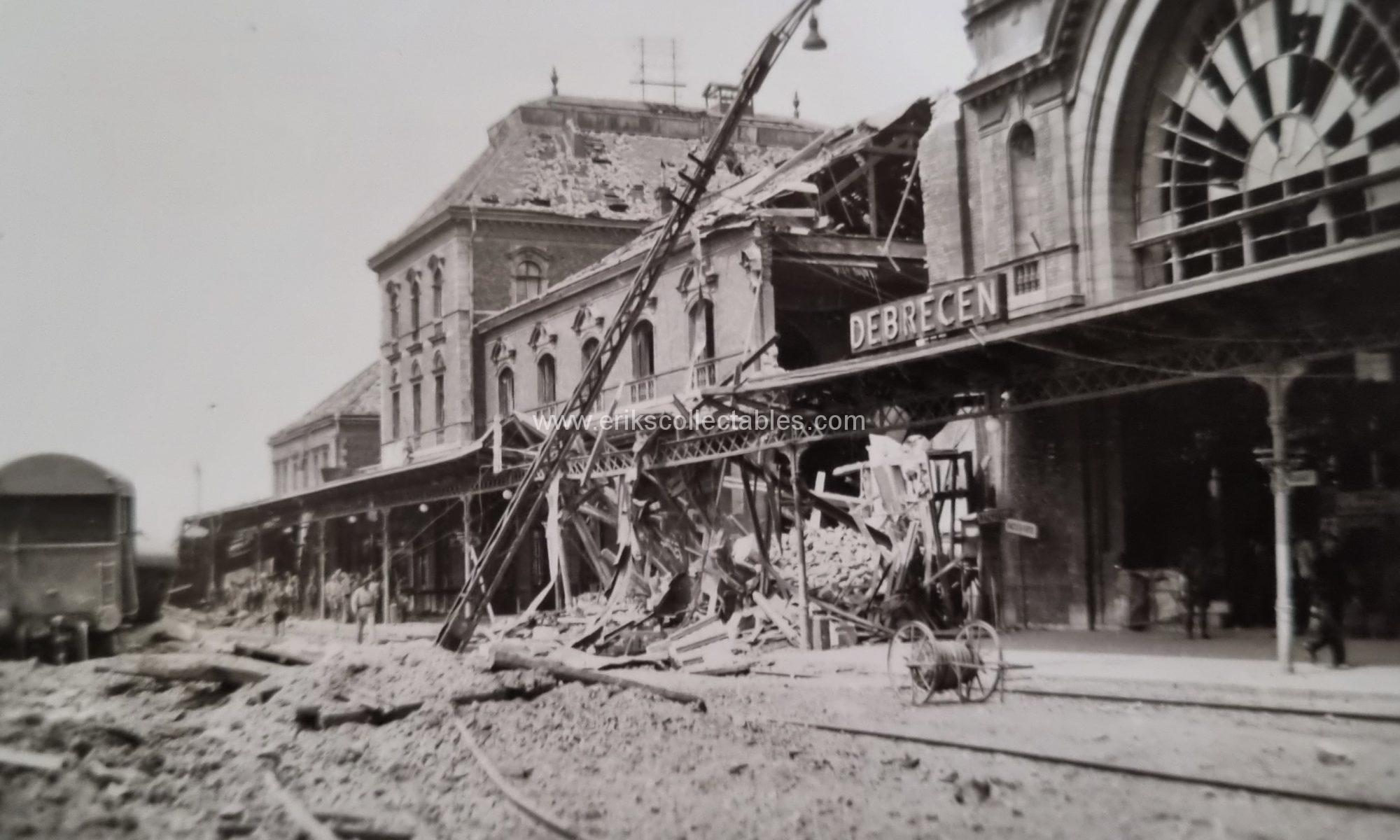
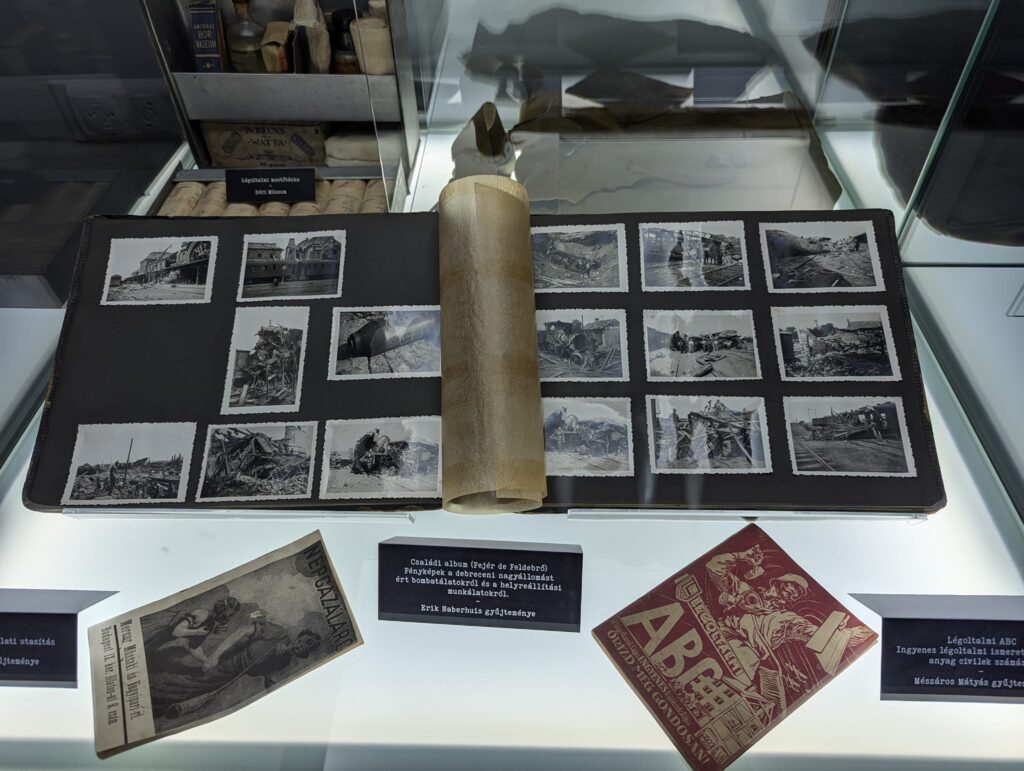
Two groups of photo’s help to establish the exact timeframe and specific context of a part of the album. They show two heavily bombed railway stations in Debrecen and Szolnok and their damaged surroundings, railways and trains.
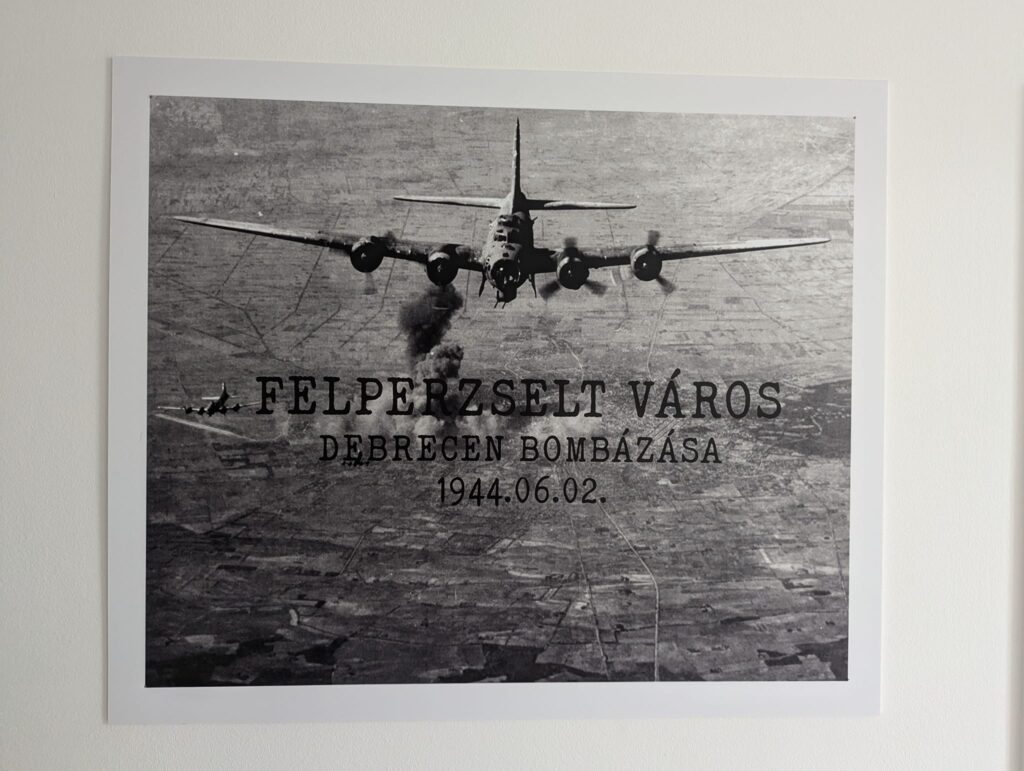
Both cities were bombed as part of American shuttle raids which were executed during Operation Frantic that took place between June and September of 1944. This was one of the few direct operational cooperations between the Russian and American forces. Bombers of the 8th and 15th US Army Air Force would undertake bombing flights on the way between bases in the UK and Italy to locations in Ukraine where they would reload with bombs and fuel and on the return flight again would bomb targets that were agreed upon between the Russian and US forces. That is why these were called shuttle raids, the planes would shuttle between the bases in Western and Eastern Europe and bomb targets on the way in between.
On the first and the last flight of Operation Frantic there would be also Hungarian targets. On the first flight on June 2nd Debrecen would be one of the targets. On the last flight on September 22nd Szolnok would be one to the targets. In both cases the railway station and the related area would be the main targets as these were of importance to the German military logistics, movement of soldiers and material like tanks to the Eastern front.
The photo’s show people of the Railway repair crew but also labour units working hard to repair the damages. IMostly trains and wreckage of railways and buildings but also some casualties, of which there were many due to the fact that not only railway related buildings were hit in the raids. Please be advised that photo’s of casualties are at the end of the blog.
Unexploded 500 pound bomb?
A total of 130 planes would hit Debrecen with more than 1000 bombs between 8.46 hrs and 9.00 hrs. The damage would be great but the loss of life was also enormous. Whole streets in the proximity of the railway areas would also be destroyed. Almost 1200 death and close to 700 seriously wounded would be the direct human impact of the bombing with hundreds of buildings (including many regular houses) completely destroyed.
Due to the nature of the album the photo’s are mainly of the railway related impact and not the civilian impact.
The last few pictures show casulaties of the bombings and the location were they were found. Probably most casulaties would have been removed before the repair crews started working but I assume these were uncovered during the repair works.
I cannot express the sadness I felt seeing that little shoe sticking out between the big boots of the men under the cover of tent halves…
Carl started in the KuK (Schutzen) Landwehr Infanterie Regiment 21 (Sankt Pölten) and later his machinegun group moved to the Landsturm Infanterie Regiment Nr. 51.
Sometimes as a collector you come across a grouping that is quite unique as in this case. At the moment I am still contemplating what my next step will be….A series of blogs, a dedicated website or even a book…
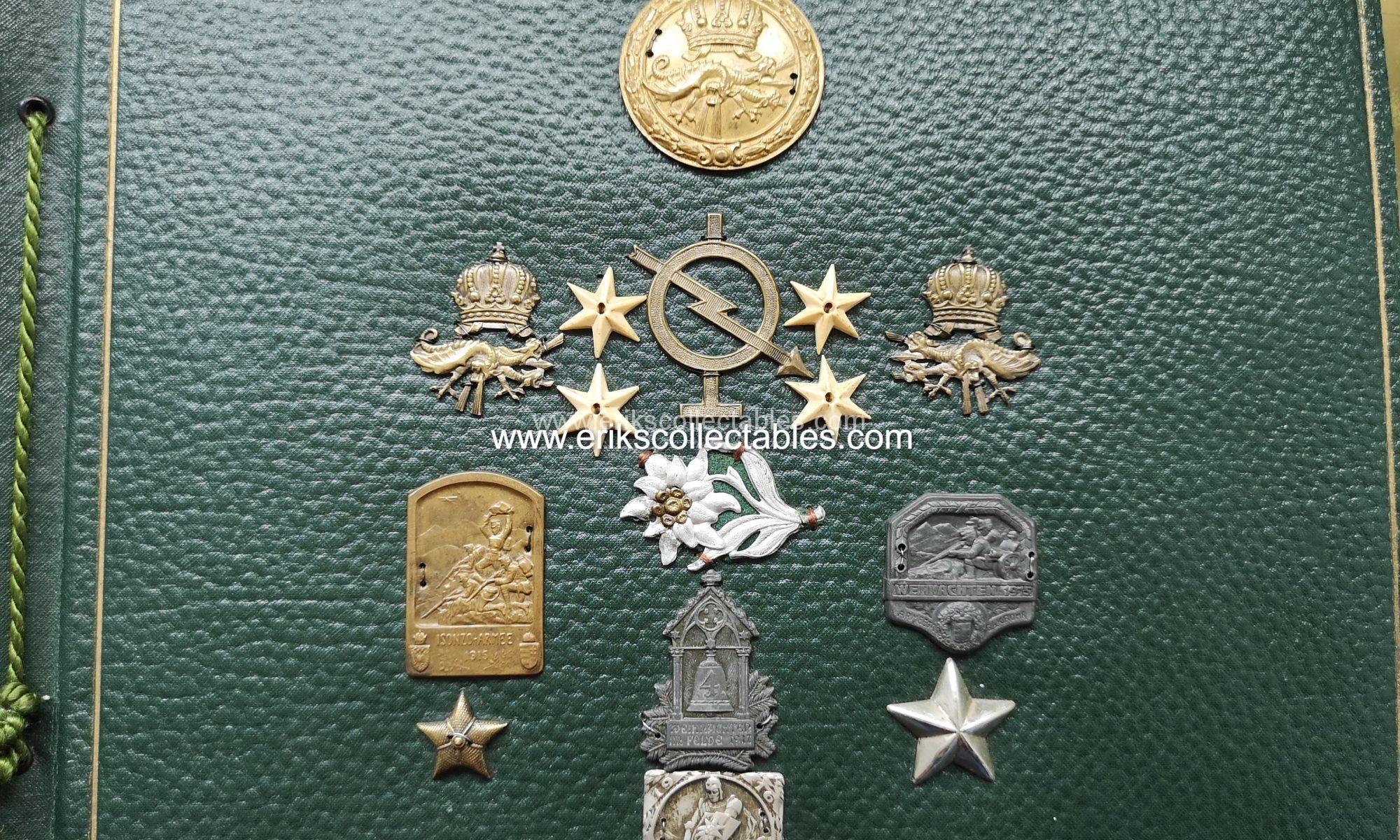
The group contains a photo album with a cover with badges of Carl, many postcards and a short diary. Loads of information on some very relevant moments in WW1 including the Isonzo battles.
Until I have decided what to do only a small placeholder blog with some teaser materials…
The album contains many official photo’s, but also private photo’s and even WW2 related photo’s. Also many captured Italian photo’s and some leaflets (Flugblätter). So for now only this teaser…
This is a group of documents to Adolph Straub from 1851 who was a Stabs Auditor (Military Judge) in the Kingdom of Lombardy-Venetia which was in Austrian hands at that moment. Fieldmarshall Count Radetzky was the commander / viceroy of that region from 1848 until his death in 1858.
And on the following page from the ranklist of 1851 we find Straub:
Stabs-Auditor (Military Judge) Adolph Straub was awarded the Iron Crown Order 3rd class in 1851. Officially the number of recipients was limited to 50 in the original statutes but this was no longer the case in 1851 nevertheless it still was a rare order.
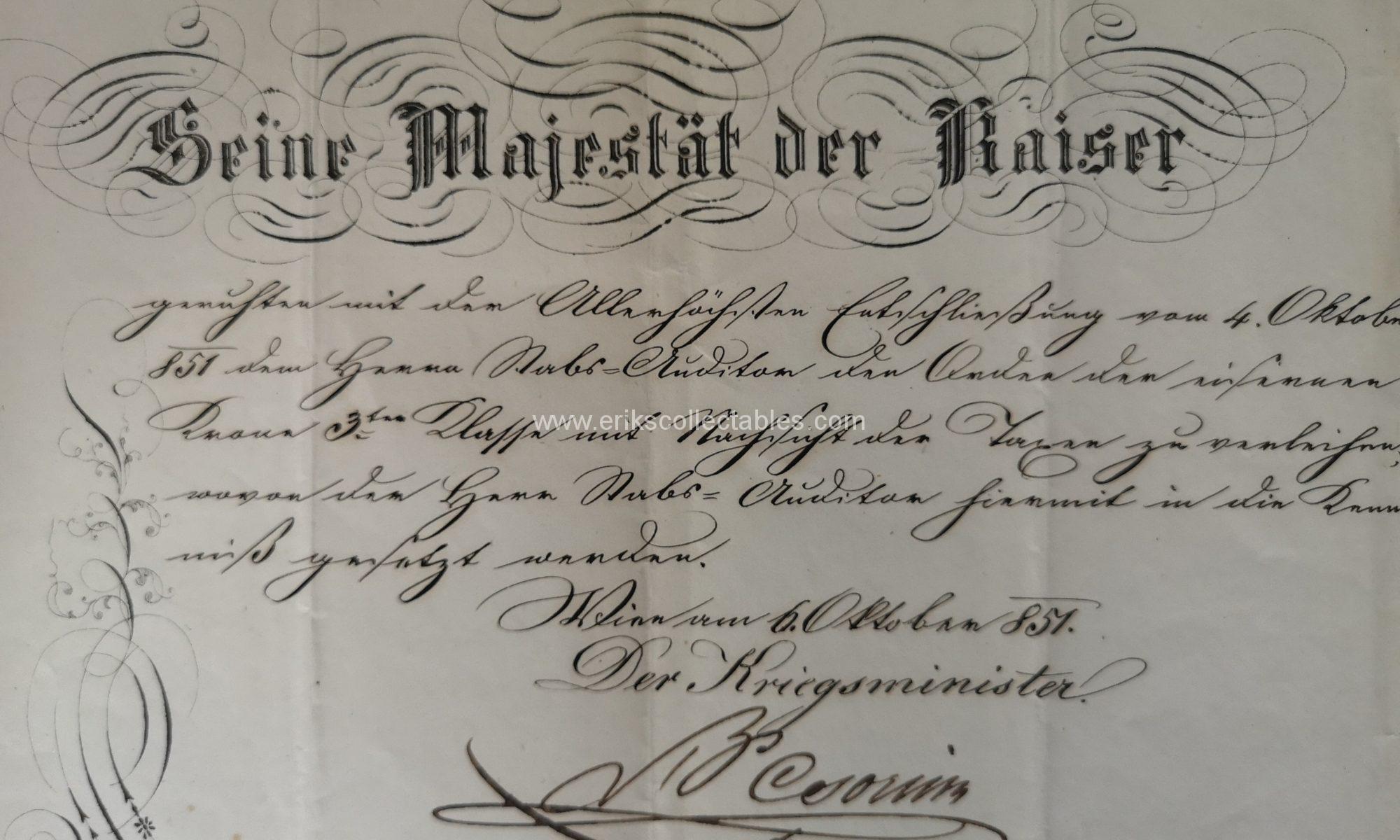
Below the formal award document signed by the Minister of War Feldzeugmeister Csorich.
Fieldmarschall Radetzky as commander of Straub also communicated with him regarding the award which leads to the letter below to Straub including the original signature of Radetzky and the use of his personally marked paper (often more generic paper was used in general communications!).
So this group of documents if for an important order but also with some very rare signatures in Austro-Hungarian history.
Worldwar 1 started with the declaration of war against Serbia by the Austro-Hungarian empire in 1914 and was the start of the Serbian campaign. This campaign was largely unseccesfull until the attempt that started on October 7th, 1915. This last campaign ended on November 24th of the same year.
In this last campaign against Serbia were the following forces: the Bulgarian First Army commanded by Kliment Boyadzhiev, the German Eleventh Army commanded by Max von Gallwitz and the Austro-Hungarian Third Army commanded by Hermann Kövess von Kövessháza, all three under the control of the German Field Marshal August von Mackensen.
WW1 period map from internet
Until the end of WW1 the Banat region was part of Hungary which was again part of the Austro-Hungarian empire. The small city of Fehertemplom, or in German Weisskirchen, was in that region and bordered with Serbia. After the war as a result of the Trianon treaty the region would be split and Fehertemplom would become part of Serbia.
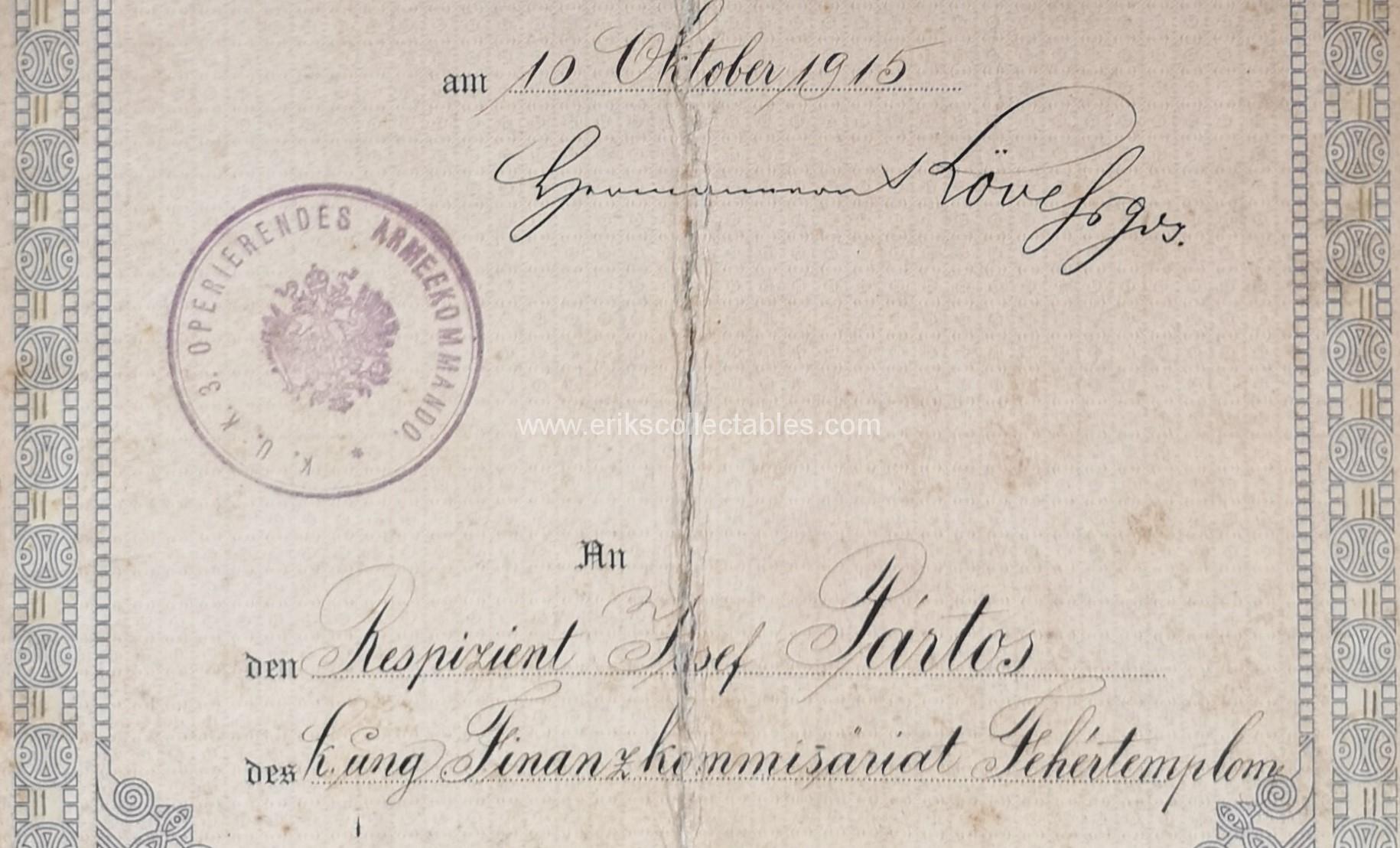
Josef Pártos was a finance official in the rank of Respizient in the Royal Hungarian Finance Commission of the city of Fehertemplom.
He received two separate document for a “Belobende Anerkennung” roughly a “mention in despatches”. This is more or less one step below the merit medal (often known as Signum Laudis based on the text on the reverse of the medal) and in this case also in the face of the enemy. So with wartime ribbon and swords if the medal indeed was given (swords were added only later in the war to the ribbon).
What he exactly did to earn this commendation is a mystery and probaby will remain so (no military records). But it must be quite unique for a finance person to qualify! Based on location and date it most probably was linked to the final Serbian campaign that started on October 7th 1915 especially as the first document is awarded by the 3rd Army command (one of the 3 armies involved in that action as discussed above) and hand signed by its Commander Kövess von Kövessháza!
Photo with signature of Kövess – from internet
The second document is from the regional command of Banat.
For this man, sergeant Deli Jószef, I still have to research the background of his medals but below his full entitlement.
From the 1939 Vitéz yearbook
Before the war he completed his compulsory service in the 44th KuK Infantry Regiment reaching the rank of sergeant in the reserve and also qualifying as a sharpshooter. His name originally was Doszpod!
Deli and his wife in the first years of the war based on his uniform. He already has the two Silver Bravery Medals.
In 1924 he became a viéz and in that process changed his name to Deli! If the applicant had a non Hungarian name one of the requirements was to change the name to a typical Hungarian one. This was the reason some did not apply as they did not want to change their names! This often leads to difficulties in researching vitéz backgrounds, if the name was changed, as the original name is not recorded!
The original diploma in poor condition as found
And the same document after professional restoration
In the 1920s he became not only a vitéz but he also applied for the grant of land which he indeed received as one of about 5500 of the more than 24.000 vitéz.
Grand diploma for the grant of land in prestine condition!
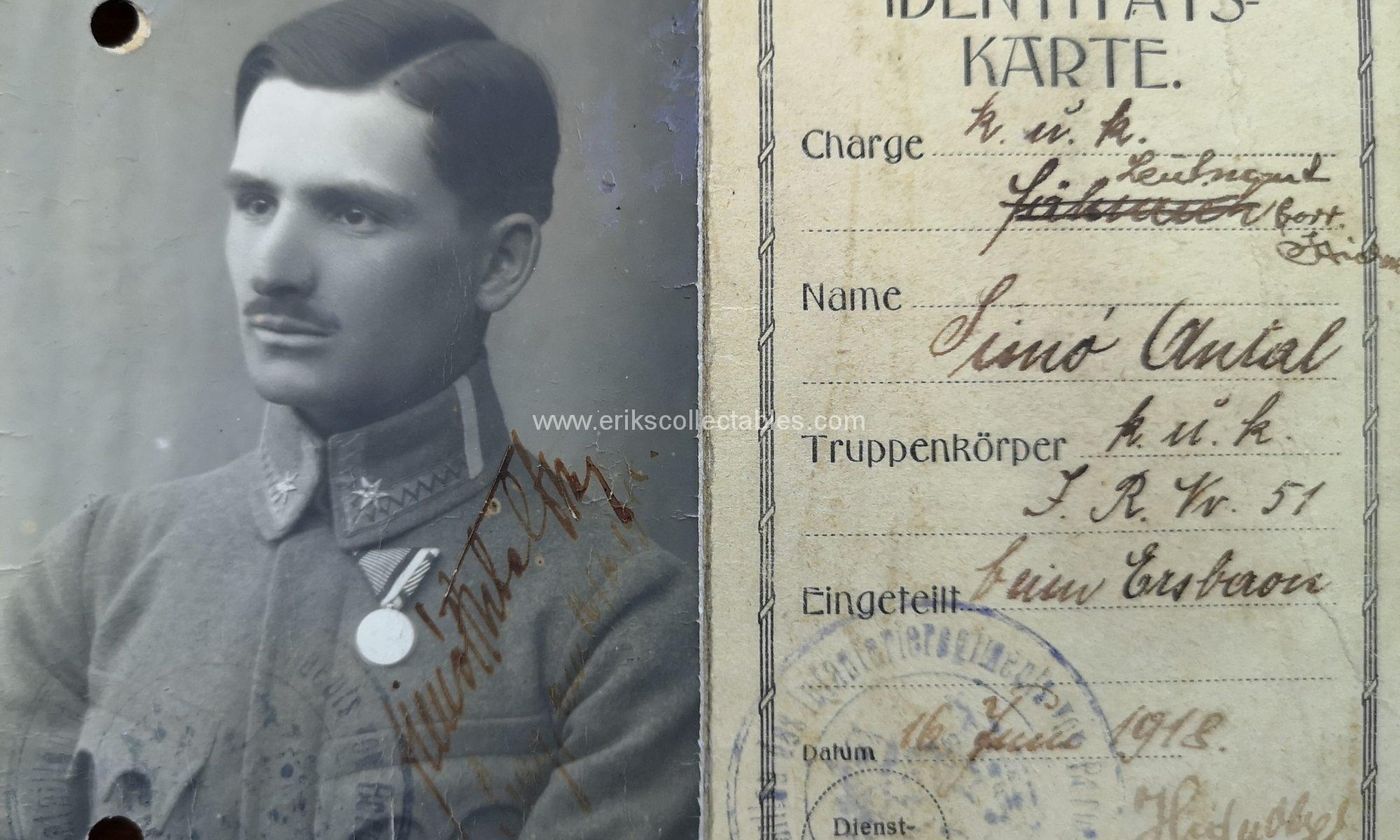
This group consists of the documents of Antal/Anton Simó, lieutenant in the reserve of KuK Infantry Regiment 51. As he lived in the Transylvania region he became a Rumanian citizen after WW1 as a consequence of the Trianon treaty.
In 1941 as a result of the last Hungarian re-annexation action Transylvania became part of Hungary and he became a Hungarian citizen again. All the Austro-Hungarian medals could be worn and used in Hungary but obviously not in Rumania.
So in 1941 he could apply for all his relevant WW1 medals and also apply for the vitéz order as a Hungarian citizen. He also moved to Budapest and worked for the Hungarian railways. (MÁV).
His ID card from 1918 showing him with the 2nd class Bravery medal and with the rank and photo of fähnrich, later crossed out and changed in Leutnant. As all officers in training he first went through the nco ranks in which period he was eligible for the Bravery Medals to the ranks below officer!
His Bravery medal 2nd class would be awarded for actions in 1916 as described below in the request form. The request forms come from the Hugarian Military Archives!
From the Hungarian Military Archive.
Text of the request:In Annerkennung tapferen Verhalten vor dem Feinde. Im Gefechte vom 7. und 8. Juli 1916 Sudlich Podgaino Ubernahm er nach Verwunding des Zugskommandanten das Kommando in dem Zeitpunkt als der Feind bereits an der innersten Hinderniszone war und drangte denselben durch seine Entschlossenes tapferes Aufträten wobei er an der spitze sienes Zuges Kämpfte zuruck. Bracht ihm durch geschickte Feuerleitung grosse Verluste Bei.
Translation:In recognition of brave conduct in the face of the enemy. In fight from 7th and 8th of July 1916, south of Podgaino. He took over command, after the commander became injured, at the moment that the enemy already was at the innermost defense line and forced them back, by his convincing brave action, in which he fought at the front. Inflicted great losses to the enemy by his adequate fire direction.
From the history book of the Worldwar, book II, 1920: 7. Juli griffen zwei neue russische Korps im Räume Karczewo-Wygoda das Kolozsvärer Infanterieregiment Nr. 51 an, ‘das bei Tuganowiczi und Podgaino stand, heldenmütig die Stellung hielt und alle Angriffe erfolgreich abwies. Am 8. Juli 2 Uhr vormittags erfolgte ein erneuter heftiger Angriff, welcher den ganzen Tag andauerte. Vor der Front der 51er lagen über 2000 Tote, ohne daß das tapfere Regiment auch nur einen Schritt zurückgewichen wäre.
Translated:On July 7th two Russian corps attacked in the area of Karczewo-Wygoda the 51st Infantryregiment from Kolosvar that bravely held the line near Tuganowiczi and Podgaino and rejected the attack succesfully. On the 8th of July at 14.00 hrs a new attack was launched that lasted the entire day. In front of the 51st there were more than 2000 death without the Regiment retreating even a step.
And the documents and texts relating to his first class Bravery Medal
Tapferes Verhalten vor dem Feinde: In der Durchbruchsschlacht am 24./X. 1917 bei (Punkt) 778 nördl Dol. Kal stürmte er mit der 1. Welle der 7. fkomp bis über die 2. fdl. Linie, wo er infolge schwerer Verwundung abbleiben musste. Er gab ein mustergültiges Beispiel seiner Mannschaft.
Request form and detail from the Hungarian Military Archives
Translation of text:Brave conduct in the face of the enemy. In the breaktrough fight on the 24th of October 1917 at point 778 north of Dol. Kal. he stormed with the first wave of the 7th field company beyond the 2nd enemy line, where he, as a result of a major injury, had to stay behind. He was an example to his men.
The villages Kal and Dol Kal can be found at the position (roughly) 46°5′ North and 31°24′ East
The date of this action is the start of the 12th Isonzo battle in Italy! In October 1917 the Kolozsvárer IR.51 took part in the Isonzo / Karfreit breakthrough. The villages are Dol (east of Selo) and Kal (im Cepovantale). The regiment (three battalions) was together with IR.64 a part of the 69th Infantry Brigade. The regiment held a sector in the Cepovan Valley (Capovantal) on the Bainsizza Plateau.
Official document/certificate confirming his both Bravery medals
As stated his other medals would be added only after 1941:
Karltroop cross certificate
Wounded medal with one stripe on the ribbon.
Hungarian WW1 commemorative medal
And finally his invitation to the vitézi rend award ceremony in 1943.
His entitlement in 1943 would have looked like this (these are not his medals as the group only existed of the papers).
With many thanks to the Hungarian Military Archives for helping with the relevant materials that made this blog possible!
And a last document from the military archives – his military pass post from the 1950s
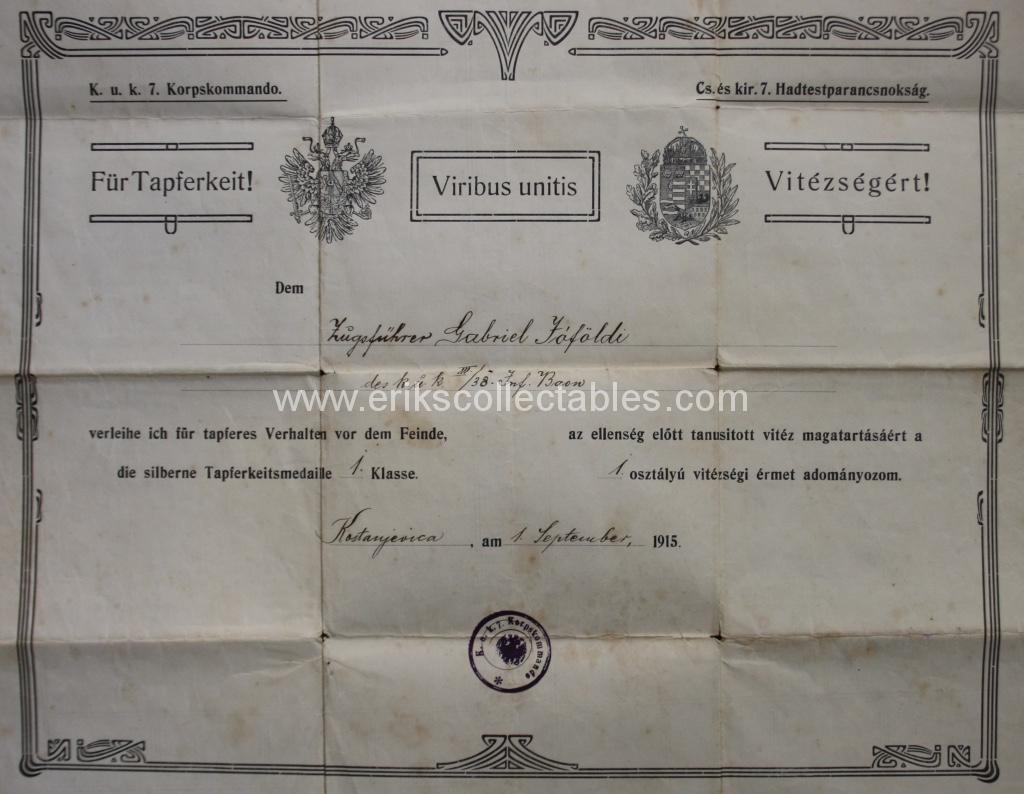
These are the documents and medals of sergeant in the reserve vitéz Jóföldi Gábor.
Complete WW1 entitlement including vitéz order and certificate
The following information comes from the history of the 38th KuK regiment by József Doromby :
Photo from the regimental book.
“He was born in 1885 in Bogyiszló. In 1907-09 he fulfilled his military duties in Bilek. He was involved in the mobilization and trained as a reserve NCO until January 15, 1915. After that he went to the Serbian front, and from there on May 13, to the Italian front. He went to Doberdo, Italy and then he was taken back to the Serbian front and then again to the Italian battlefield, from where in April 1916 he was taken sick to the hospital. After his recovery, he was commanded to the Russian, Romanian and finally again to the Italian front. Wife: Judit Bencze; children: Judith, husband. Mrs. János Sánta, Gábor, Lidia, husband. Mrs. Józsefné Németh, Ferenc. “
The piece in the book also give his full medal list as shown above. He did not qualify for the Wounded Medal as his period in hospital was due to illness, not wounds received in battle.
His Silver Bravery Medal 1st class would be the basis for his later (1929) introduction into the vitéz order. Below the full size diploma which is quite rare as most units only handed out the small certificates for in the legitimation capsule.
Below some other papers, his 1919 release from service papers, the certificate for his Karltroop cross and his Hungarian WW1 remembrance medal.
He was mobilized again for WW2 (Igazolvány lap in the top middle) but probably did not see any action due to his age.
All papers and medals came from the family and are a real group. Below a “Kappenabzeichen” of the 38th KuK Infantry Regiment in which he served (my collection but not part of his estate!)
With thanks to Zoltán Sőregi for finding the regimental information!
Sergeant in the 44th Infantry Regiment (Erzherzog Albrecht Nr. 44). Awarded with the Austro Hungarian Golden Medal for Bravery. The highest possible award in the Austro-Hungarian Army for ranks below officer.
For his actions he was awarded the Hungarian title vitéz and the order in the interwar period you can read more about the Vitézi Rend in the earlier blog.
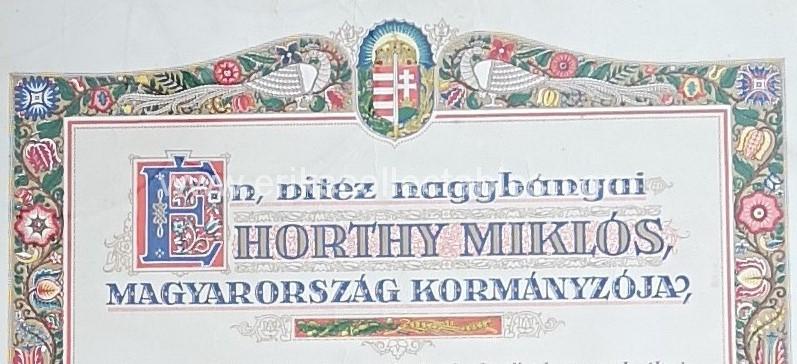
Grand diploma of the order, handsigned by Regent Horthy.
Below the excerpt from the 1939 Vitéz Albuma:
Awards as stated in the list in the yearbook:
Golden Bravery medal
Silver Bravery medal 1st Class, 2 times
Bronze Bravery medal
Karl Troop cross
The short version of his citation as recorded in the Golden Medal award records in the Austrian Military Records
Im Gefechte vom 12/3 auf den 13/3 (1915) am Brdo Bewies er beispeillose Unerschrockenheit u. heldenhafte Tapferkeit. Kam bis auf 40x vor der fdl Stellung. Trat den Ruckzug trozt des Befehls erst nach 2 Stunden als letzte abt der Angr. Gruppe an.
Which translates as follows:
In the fights of 12/3 and 13/3 in Brdo he showed unprecedented fearlessness and heroic Bravery. Came up to 40x before the enemies position. Retreated, despite the order, only after 2 hours as the last of the attacking group.
His feats where also published in a Hungarian book (A MAGYAR NEMZETARANYKONYVE 1914-1918.” Budapest, 1921. – Golden book of the Hungarian nation 1914-1918 ) which describes the action as follows:
“He ran forward in the killing adverse drum-fire of the enemy as the head of his platoon and during the assault he exhorted his comrades. The regiment met irreplaceable and heavy losses, so sergeant Janos Horvath got the order to withdraw his fellows from the first line. Horvath was forty paces off the enemy and he sent back a message that they will not leave the line as long as the wounded comrades of the neighboring unit (3rd Bosnians) have not been recovered. Finally he withdrew his men two hours later and he was the last soldier who left the front line.”
His Vitézi Rend Award which is numbered and has the initials of Horvath.
And the certificate that belongs to the award
Replacement Golden Bravery Medal (gilded bronze in the Karl version, interwar period). This came directly from the family but is a replacement. The original will have been a real gold FJ type that probably was sold for mentary reasons as happened very often. Next to this his large Silver Bravery Medal with bar for the 2nd award. The Bronze Bravery Medal and the Karl Troop cross were no longer part of the group so I have not included them either.
Free public transport travel cards to the winners of the Golden Bravery Medal including his photo ID with signature.
The original award request forms as they remained in the Hungarian military archives!